
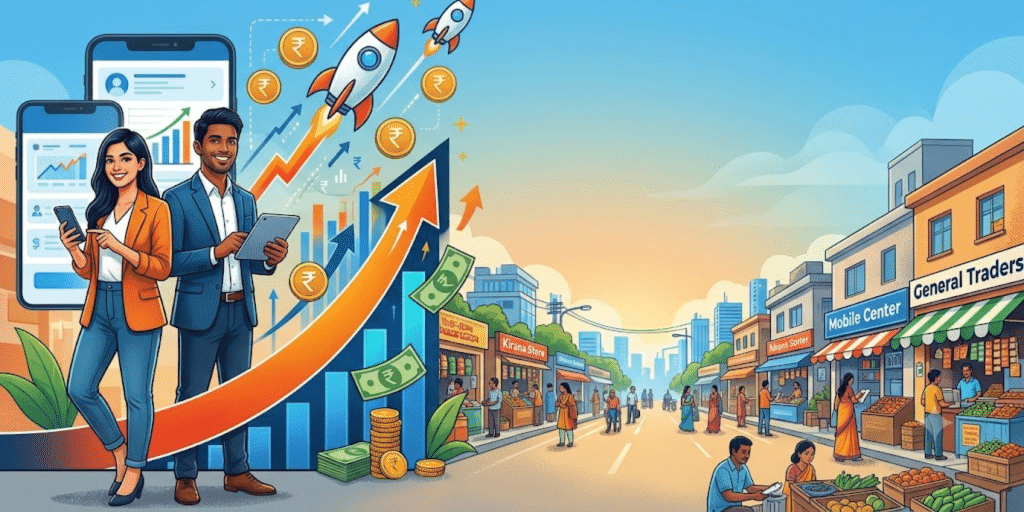


India’s financial landscape is undergoing a massive transformation. For decades, access to formal credit, insurance, and investment products was strictly concentrated in major metro hubs like Mumbai, Bengaluru, and Delhi NCR. Small business owners, local retailers, and aspirational families in Tier-2, Tier-3, and rural towns were left relying on informal moneylenders or navigating cumbersome traditional bank branches.
Today, Bharat is changing rapidly. Widespread mobile internet adoption, UPI digital payment networks, and digital identity infrastructure have opened unprecedented doors for local entrepreneurs. You no longer need a computer science degree, deep venture capital funding, or a team of software developers to launch a high-margin financial distribution enterprise.
Unlocking fintech business opportunities tier 2 india has become one of the most reliable ways for ambitious non-tech founders to create compounding, recurring income streams. By bridging the gap between national financial institutions and trusted local communities, local distribution partners build highly profitable, sustainable businesses while serving their regional economies.
Why Tier-2 India Is the Undisputed Frontier for Digital Financial Services
Understanding the underlying demographic and economic shifts across India’s growing regional cities reveals why financial distribution is booming outside metro areas.
Want to Turn Ideas Into Opportunities?
1. The Credit Gap in Regional Enterprise Ecosystems
Tier-2 and Tier-3 cities host millions of micro, small, and medium enterprises (MSMEs)—from textile traders and manufacturing units to regional retail stores and logistics providers. While these businesses generate steady cash flows, traditional banks often struggle to serve them efficiently due to manual paperwork and slow credit evaluation processes. Digital lending platforms bridge this gap by evaluating alternate financial data, allowing local distribution partners to fulfill credit demand quickly.
2. High Local Trust vs. Low Financial Literacy
Financial decisions in regional India are built heavily on personal trust and long-standing relationships. A customer in Surat, Jaipur, Indore, or Coimbatore may feel intimidated filling out complex online loan applications on a smartphone screen. They prefer working with a trusted local expert who can walk them through digital options, verify documents, and ensure smooth approval. Non-tech founders leverage this human relationship network to build long-term business moats.
Exploring fintech business opportunities tier 2 india allows local entrepreneurs to turn regional community relationships into scalable, recurring financial distribution networks.
The 4 High-Margin Fintech Business Models for Non-Tech Founders
You do not need to build core banking software from scratch. Instead, non-tech founders act as strategic distribution partners using pre-built API platforms, SaaS dashboards, and white-label mobile applications.
Model 1: Digital Loan Partner & Direct Selling Agent (DSA)
Operating as a modern digital Direct Selling Agent (DSA) is one of the fastest, low-overhead ways to start. Instead of dealing with physical loan files and chasing branch managers, digital DSAs use unified partner dashboards to match borrowers with multiple banks and non-banking financial companies (NBFCs).
- Target Products: Personal loans, business expansion loans, working capital lines, and loan against property (LAP).
- Revenue Mechanism: Payout commissions ranging from 1.5% to 3.5% of the total disbursed loan amount. Disbursing ₹1 Crore in monthly business loans yields a direct monthly income of ₹1.5 Lakhs to ₹3.5 Lakhs.
Model 2: POS Merchant Digitization and Business Credit Enablement
Local retail stores and Kirana shops need digital point-of-sale (POS) machines, QR code soundboxes, and digital ledger systems to accept customer payments and manage daily operations.
- Value Addition: By onboarding local shopkeepers onto unified payment and merchant dashboards, partners help retailers build verified transaction histories.
- Monetization: Partners earn upfront hardware setup commissions alongside recurring revenue cuts on merchant daily transaction volumes and short-term working capital loans disbursed to retailers.
Model 3: Digital Micro-Insurance and Healthcare Cover Distribution
Insurance penetration across non-metro India remains low. Micro-insurance products—such as sachet-sized health policies, shopkeeper property cover, two-wheeler insurance, and term life plans—present massive distribution potential.
- Recurring Model: Insurance distribution generates compounding annual renewal commissions. Every policy renewed by a customer in Year 2, 3, and beyond pays continuous passive commissions to the partner.
Model 4: Assisted Financial Services & AEPS Hubs
In semi-urban and rural centers, establishing an Aadhaar Enabled Payment System (AEPS) and micro-ATM service hub allows local residents to withdraw cash, transfer funds, pay utility bills, and deposit savings securely.
- Customer Lifetime Value: AEPS hubs build high daily foot traffic, providing cross-selling opportunities for high-margin business loans, gold loans, and monthly mutual fund systematic investment plans (SIPs).
Thoroughly evaluating fintech business opportunities tier 2 india allows ambitious agency owners to select the most profitable financial products for their local market. When entrepreneurs build their product portfolio around fintech business opportunities tier 2 india, they create multiple recurring income streams through loan payouts, insurance renewals, and payment terminal fees.
Proactively researching fintech business opportunities tier 2 india enables local entrepreneurs to identify credit gaps across regional industrial clusters and commercial markets. Integrating insights regarding fintech business opportunities tier 2 india into your business model ensures that your agency offers targeted credit solutions that match the specific cash-flow needs of regional shopkeepers and MSMEs.
Want to Turn Ideas Into Opportunities?
Discover digital business opportunities with the right tools, expert guidance, and dedicated support to start and grow your business.Get Started
Earnings Potential Matrix across Financial Distribution Models
Understanding commission structures across different financial products helps non-tech founders optimize their daily sales outreach:
| Financial Product Category | Average Payout / Commission | Revenue Type | Target Audience in Tier-2 Markets |
| Unsecured Business Loans | 2.0% – 3.5% of Disbursed Amount | Upfront One-Time | Local MSME Owners, Traders, Contractors |
| Personal & Professional Loans | 1.5% – 2.5% of Disbursed Amount | Upfront One-Time | Salaried Employees, Healthcare Workers |
| Two-Wheeler & Auto Insurance | 15% – 25% of Annual Premium | Upfront + Annual Renewal | Vehicle Owners, Delivery Fleet Operators |
| SME Health & Property Insurance | 10% – 20% of Annual Premium | Compounding Annual Renewal | Shopkeepers, Factory Owners, Showrooms |
Analyzing fintech business opportunities tier 2 india against these earnings potential metrics allows founders to construct balanced product portfolios combining instant cash flow with long-term recurring payouts.
7 Secrets to Scale a Regional Fintech Business Without Tech Expertise
Transitioning from a solo referral agent into a structured regional fintech agency requires operational clarity. Here are seven secrets used by successful non-tech founders across India:
Secret 1: Partner with Established Digital Aggregator Networks
Avoid trying to negotiate separate corporate deals with 30 individual banks when starting out. Join accredited fintech aggregator platforms and master distribution networks that provide instant access to multiple lending and insurance partners through a single, easy-to-use mobile application.
Secret 2: Master Localized Digital Content & WhatsApp Marketing
Your regional customers communicate primarily in local languages. Create simple WhatsApp video explainers, vernacular educational posts, and customer success stories in Gujarati, Hindi, Marathi, Tamil, or Telugu. Sharing clear, jargon-free explanations builds immediate community authority and high inbound lead traffic.
Secret 3: Build a Field Referral Network of Local Chartered Accountants & Tax Consultants
Chartered Accountants (CAs), GST practitioners, and local tax consultants hold deep, high-trust relationships with regional business owners. Offer revenue-sharing partnerships to local CAs where they refer clients needing business expansion loans, while your agency manages the digital application and approval workflow.
Secret 4: Maintain Absolute Transparency and Ethical Advisory
Avoid hidden processing fees or false approval promises. Clearly explain interest rates, loan tenure terms, and processing charges to prospective borrowers. Ethical advisory builds long-term client trust, resulting in repeat loan applications and organic word-of-mouth referrals.
Secret 5: Focus Heavily on Micro-MSME Working Capital Demand
While large enterprise loans carry long approval cycles, micro-business loans (₹2 Lakhs to ₹15 Lakhs) process rapidly through digital credit scoring algorithms. Focusing sales operations on fast-turnaround MSME working capital keeps cash flow moving steadily.
Secret 6: Hire and Train Local Feet-on-Street Field Executives
As monthly commission payouts grow, scale your reach by hiring energetic local field representatives. Provide your field staff with smartphones equipped with digital partner applications, allowing them to visit local industrial parks and commercial markets to collect customer documents digitally on the spot.
Secret 7: Build a Systemized CRM and Annual Renewal Tracker
Track every customer application in a organized digital customer relationship management (CRM) tool. Set automated WhatsApp reminders for insurance renewals, loan top-up eligibility, and annual financial reviews. Systematic follow-ups turn one-time customers into lifelong recurring revenue sources.
View the Resource → The Tier-2 & Tier-3 Founder: Building Startups Beyond India’s Metros
Applying these seven operational principles guarantees that exploring fintech business opportunities tier 2 india builds a sustainable, high-margin financial distribution enterprise.
Want to Turn Ideas Into Opportunities?
Mastering the execution framework behind fintech business opportunities tier 2 india empowers local distribution partners to expand their field team without sacrificing service quality. Aligning your daily sales pipeline with fintech business opportunities tier 2 india guarantees that your financial agency maintains strong client relationships and high approval rates across regional markets.
Technical & Infrastructure Readiness for Financial Distribution
Running a modern, high-volume financial agency requires reliable web touchpoints and fast digital customer communication systems.
When setting up branded customer portals or digital application hubs, non-tech founders evaluate custom software development vs off-the-shelf software to ensure they balance low upfront investment costs with seamless API integrations and zero technical maintenance friction.
Building an authoritative regional brand presence through a custom-built website provides fast mobile loading speed, improves local search visibility on Google Maps, and allows prospective borrowers to submit loan inquiries securely.
Furthermore, deploying modern full-stack development solutions gives growing financial agencies a secure database architecture capable of storing client records safely while complying with data protection guidelines.
Furthermore, exploring fintech business opportunities tier 2 india emphasizes the necessity of deploying simple, secure customer submission portals and digital lead trackers. Structuring your agency’s online channels around fintech business opportunities tier 2 india guarantees that your team captures client data safely while complying with data protection guidelines.
Step-by-Step Execution Guide to Launching Your Regional Fintech Agency
Follow this simple execution roadmap to launch your financial distribution business from scratch:
Step 1: Complete Partner Registration and KYC Compliance
Register your legal business entity (Proprietorship or LLP) and complete partner registration on accredited digital loan and insurance distribution platforms. Obtain necessary certifications (such as POSP registration for insurance distribution).
Step 2: Establish Your Digital Hub and Vernacular Collateral
Set up a fast-loading business website and create localized digital brochures explaining your core financial offerings (business loans, personal credit lines, shop insurance).
Step 3: Initiate Outreach to Local Business Hubs
Conduct field visits to local commercial markets, industrial estates, and trade association meetings. Introduce your digital credit offerings to local shopkeepers and small manufacturers.
Want to Turn Ideas Into Opportunities?
Step 4: Streamline Digital Document Collection and Application Submission
Use mobile scanner applications to collect applicant KYC documents, bank statements, and GST returns digitally. Upload files directly to partner portals to trigger rapid automated underwriting checks.
Step 5: Track Payout Distributions and Reinvest in Expansion
Monitor commission disbursements on your partner dashboard weekly. Reinvest early earnings into hiring field executives, running localized social media ads, and expanding your regional service area.
Following a disciplined execution roadmap for fintech business opportunities tier 2 india helps non-tech founders streamline their document collection and verification workflows. Regularly reviewing your agency’s performance through the lens of fintech business opportunities tier 2 india ensures steady month-on-month growth and higher commission payouts.
Find More Helpful Resources → Why Your 5-Year Business Plan is Already Dead (And the 30-Day Digital Engine That Replaces It)
Conclusion: Take Charge of the Financial Distribution Opportunity
The democratization of digital finance across India has created a generational opportunity for non-tech entrepreneurs in Tier-2 and Tier-3 cities. You do not need complex technical infrastructure or large capital reserves to build a successful financial distribution business.
By partnering with established digital platforms, building trust within your local business community, and focusing on high-margin credit and insurance products, you can construct a resilient, cash-generative enterprise. Take action today, explore regional financial distribution opportunities, and build your recurring revenue engine in Bharat!
In conclusion, capturing fintech business opportunities tier 2 india provides non-tech founders with the financial leverage needed to scale a sustainable regional enterprise. By systematically pursuing fintech business opportunities tier 2 india, you establish an independent financial distribution hub that delivers long-term profitability.
Frequently Asked Questions (FAQs)
Q1: Do I need a background in software coding to start a digital fintech business in India?
Ans: Not at all! Modern fintech aggregator platforms provide ready-to-use mobile applications, web dashboards, and automated backend systems. Non-tech founders focus entirely on customer relationships, document collection, and local sales distribution.
Q2: How much starting capital is required to launch a digital loan agency?
Want to Turn Ideas Into Opportunities?
Ans: You can launch a digital loan distribution business with virtually ₹0 to minimal capital (under ₹10,000 for basic business registration, mobile internet, and localized branding materials), as technology platforms handle backend processing.
Q3: How are payout commissions distributed to digital loan agents?
Ans: Commission payouts are calculated as a percentage of the total loan amount disbursed by partner banks or NBFCs. Payouts are credited directly to your bank account on a bi-weekly or monthly schedule.
Q4: Is an IRDAI license required to distribute insurance products in Tier-2 cities?
Ans: To distribute insurance legally, you or your field staff can easily complete a basic digital training course and pass the Point of Sale Person (POSP) certification exam offered by licensed insurance brokers and companies.
Q5: What is the average time required to get a digital business loan approved for an MSME client?
Ans: Thanks to automated digital credit underwriting, complete bank statement analysis, and GST validation, many partner fintech platforms issue initial loan approvals within 24 to 48 hours of document submission.
